BLE 5: The Future of Tool Tracking for Construction Professionals
Why Losing Tools on Construction Sites Is No Longer Inevitable
On a construction site or in a small business, the same questions come up all too often: "Where's the hammer drill?" or "Who was the last one to use the miter saw?" This constant search for tools is part of a daily routine that is often frustrating for teams.
Beyond being a nuisance, this problem has a direct financial impact: it wastes valuable energy and results in a significant loss of work time that could be better spent elsewhere. Fortunately, digitalization offers practical solutions, and one technology stands out today for its efficiency: Bluetooth Low Energy (BLE). But why has this standard become the ideal foundation for modern tool tracking?
What is Bluetooth Low Energy (BLE) and its version 5?
Bluetooth Low Energy, often abbreviated as BLE, is a wireless communication technology designed to connect devices over short to medium distances. Unlike standard Bluetooth, which is used in your headphones, this standard is specifically optimized for extremely low power consumption.
Thanks to this efficiency, small transmitters known as beacons or tags can continuously transmit signals for years without requiring a battery change. With the arrival of the BLE 5 generation, the technology has taken a major leap forward. Where older versions (4.0 or 4.2) showed their limitations in terms of range and speed, BLE 5 has been tailored for harsh industrial environments and professional Internet of Things (IoT) applications. It offers more powerful signals and accelerated data processing, while remaining incredibly energy-efficient.
The 4 technological pillars of Bluetooth Low Energy 5 for your hardware
For companies in the construction industry, adopting BLE 5 for equipment tracking offers four major strategic advantages:
- Extended range on large sites: The range of the BLE 5 is up to four times greater than that of previous versions. On an open construction site, your tools can be detected from a distance of up to 100 meters, or even further. The signal is also more stable when passing through walls and various physical obstacles.
- Instant communication: The data transfer rate is twice as fast as before. In practice, when an employee walks past a vehicle loaded with tools, the entire inventory is scanned and updated in the app in a fraction of a second.
- Record-breaking battery life: Despite improved performance, power consumption remains minimal. A tracker installed on a machine can thus operate for three to five years, depending on its configuration, ensuring complete peace of mind.
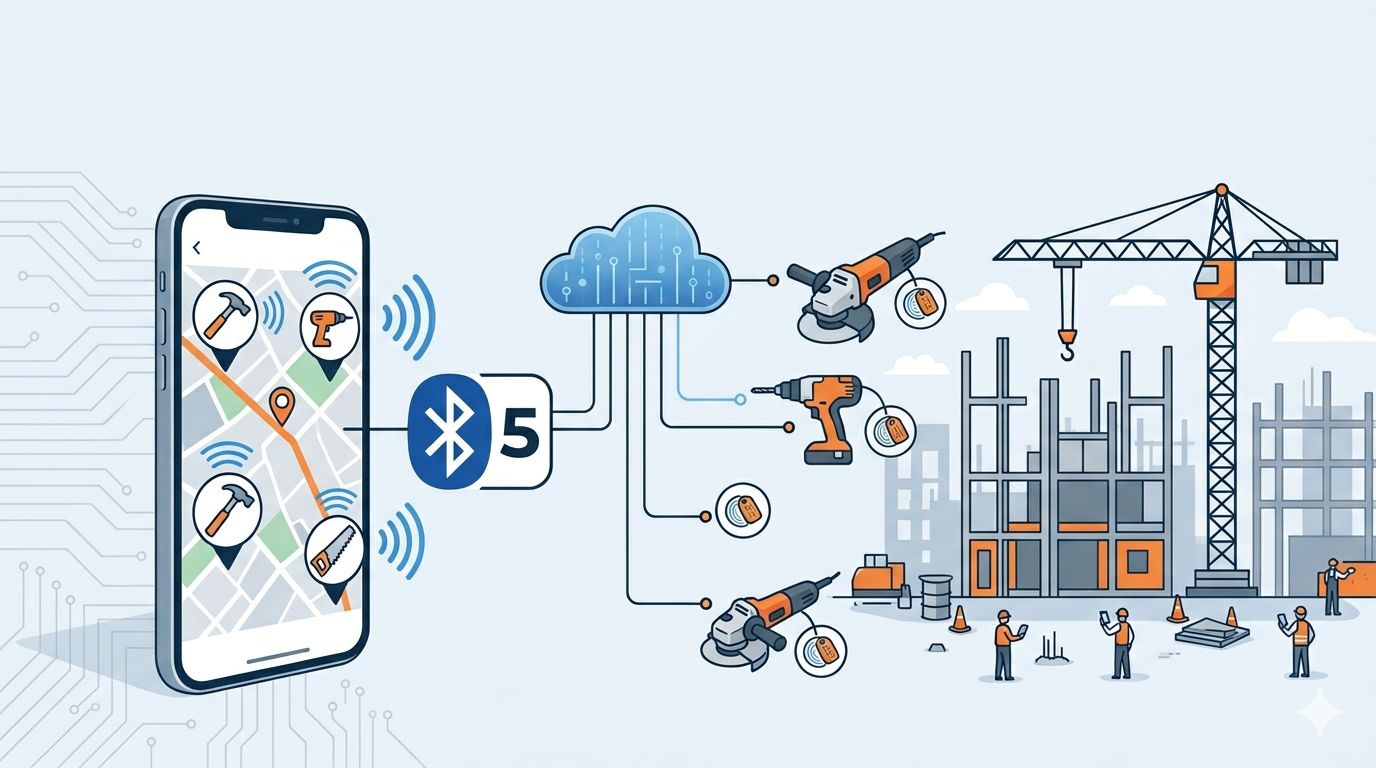
- Simplified infrastructure: This is undoubtedly the biggest advantage: you don’t need to invest in expensive scanners or complex antennas. Every modern smartphone (iOS or Android) has a compatible chip and can be turned into a mobile scanner using apps like HeronTrack.
Real-life scenarios: Bluetooth 5 for everyday use
How exactly is this technology changing the way you work? Here are the most common use cases:
1. Instant location tracking
If an employee is looking for a specific saw, all they have to do is open their tracking app. They can immediately see where and by whom the tool was last checked out, putting an end to unnecessary searches.
2. Automatic vehicle inventory
At the end of the day, when workers get back into their van, the smartphone in their pocket automatically detects all the tools loaded into the vehicle. If a tool is missing, an alert allows them to take action before they even leave the job site.
3. Maintenance and Safety
The BLE sensor serves as the tool’s digital ID. With a single scan, the user can see whether maintenance is scheduled or a safety inspection is required, thereby simplifying regulatory compliance.
4. Theft protection
Using geofencing, the system can trigger an alert if expensive equipment leaves a designated area outside of working hours. The "Last Seen" feature is then essential for quickly locating a lost or stolen device.
Why choose BLE over RFID or UWB?
There are several wireless technologies available, but BLE 5 often stands out as the best option:
- Compared to RFID: RFID often requires expensive fixed readers (gateways) and involves manually scanning each item. BLE 5, on the other hand, operates passively in the background using smartphones already in use within the company, eliminating the need for additional hardware and preventing missed scans.
- Compared to UWB (Ultra-Wideband): While UWB offers centimeter-level accuracy, it requires an extremely costly antenna infrastructure. For the needs of a typical construction site, the investment is often considered disproportionate to the benefits.
Interoperability: A Major Challenge for SMEs
European companies, and German SMEs in particular, place great importance on their technological independence. No one wants to be locked into a closed system ("vendor lock-in") that is limited to a single manufacturer.
Since Bluetooth is a global, open standard, tracking data can be easily integrated into your existing systems—such as ERP, fleet management, or inventory management software—via APIs. This ensures complete flexibility for your business’s future.
The HeronTrack Solution: The Power of BLE 5 at Your Fingertips
At HeronTrack, we designed our solution to leverage all the strengths of Bluetooth Low Energy to meet the challenges of the field.
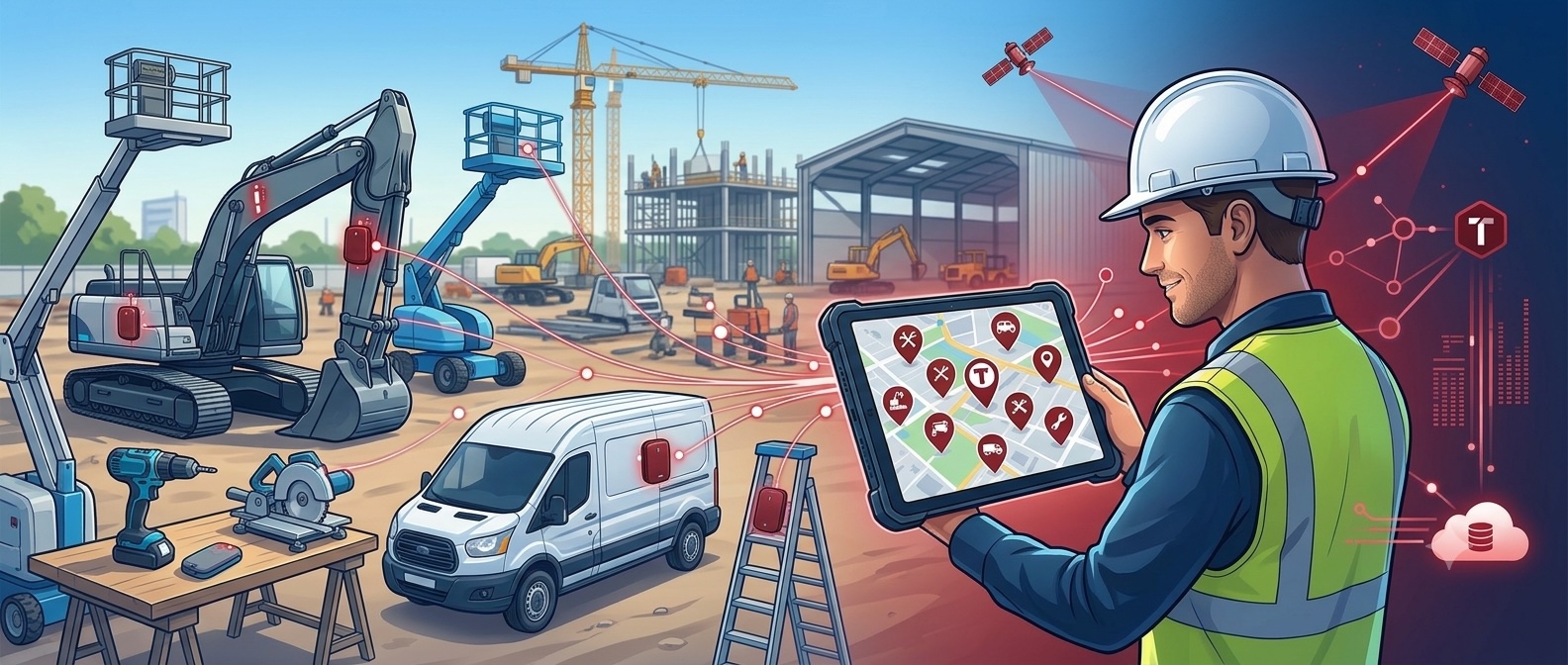
Our rugged, compact sensors can be attached to any tool, regardless of the brand. Using the HeronTrack app, every smartphone on the job site becomes an automatic scanner, with no additional infrastructure required. This way, you know in real time who is using what and where. And for your larger equipment, our ecosystem easily expands with GPS trackers for complete visibility across your entire fleet.
Would you like to digitize your tool management? Contact us to find out how BLE 5 can boost your profitability.