
An Alternative to RFID: Which Technology Is Best Suited for Tracking Tools?
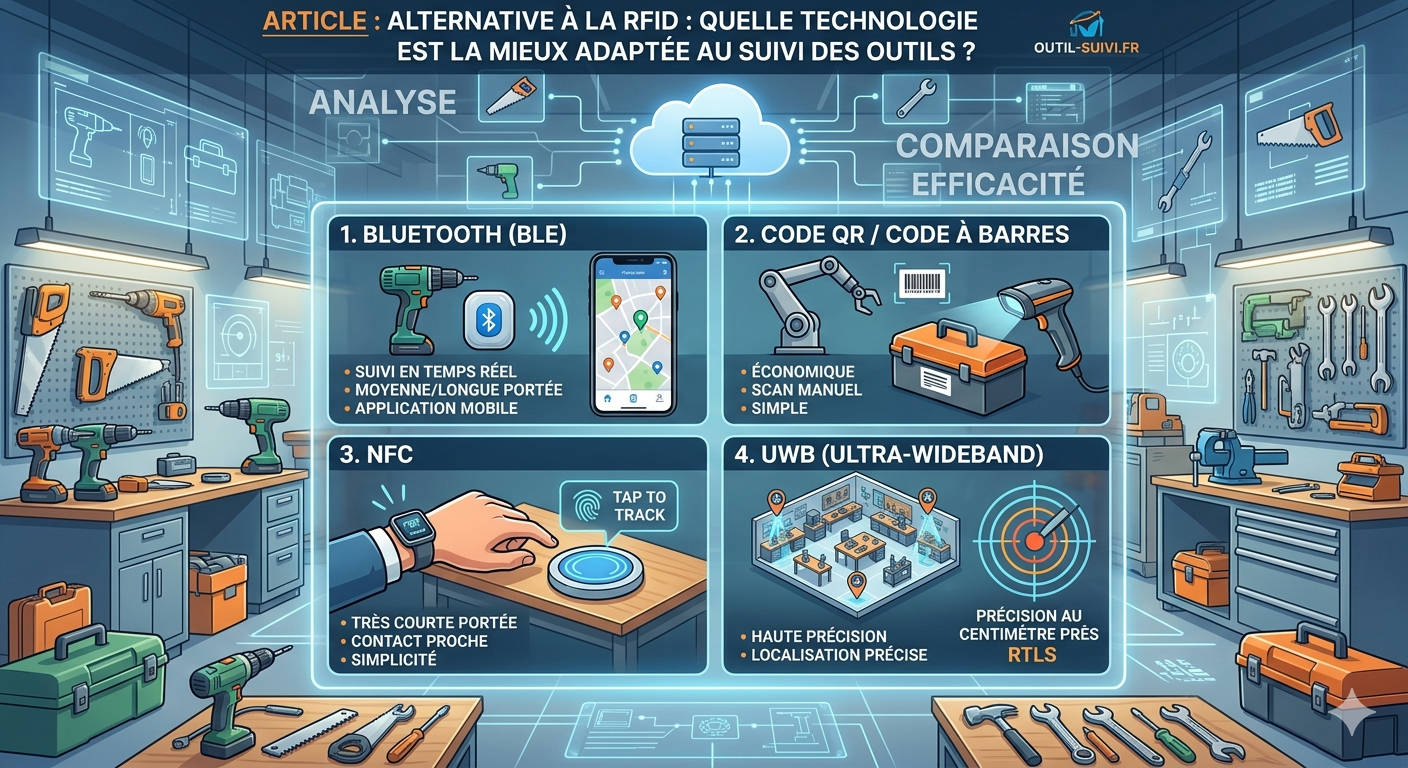
Effective management of tools and machinery is a key factor for success on construction sites and in logistics. Lost equipment not only costs money but also wastes valuable work time. For a long time, RFID was considered the gold standard for digital tracking. However, requirements are changing, and finding a more flexible alternative to RFID is becoming increasingly important for many companies.
What technologies are available on the market, what are their strengths, and which solution is best suited to your specific needs?
What is RFID, and what are its limitations?
RFID (Radio-Frequency Identification) uses electromagnetic waves to transmit data contactlessly. RFID tags are generally classified as passive (without a battery, short range) or active (with a battery, longer range).
Although this technology is well established, it often reaches its limits when it comes to modern tool tracking:
- Expensive infrastructure: To read RFID tags on a construction site, it is often necessary to install expensive readers (gateways or handheld scanners).
- Susceptibility to interference: Metal and liquids—which are ubiquitous on construction sites—can significantly disrupt the radio signal from RFID tags.
- Lack of flexibility: The technology does not provide true real-time tracking over large open areas unless there is significant investment in connected hardware.
What are the alternatives to RFID?
Since the drawbacks of RFID are particularly problematic in harsh working environments, several robust alternatives have emerged in recent years:
- BLE (Bluetooth Low Energy): Very energy-efficient, with a medium to long range (up to 100 meters), and best of all: ordinary smartphones can be used as trackers. Solutions like HeronTrack’s BLE tool trackers are based precisely on this principle.
- GPS (Global Positioning System): Ideal for global positioning outdoors. Primarily used for larger, more expensive devices.
- UWB (Ultra-Wideband): Provides extremely precise location tracking (to within a few centimeters), but is primarily designed for complex indoor environments.
- Barcodes and QR codes: Simple visual alternatives. They cost almost nothing, but require employees to scan them manually and proactively.
Which technology is best suited for which use case?
Not all technologies are suitable for every tool. Choosing the right method depends heavily on the value of the equipment and the work environment:
- Hand tools and small equipment: QR codes are suitable here for simple inventory management, or small BLE beacons if automated tracking within the utility vehicle is desired.
- Expensive power tools (hammer drills, saws): In this case, the BLE is the best choice. The tools are automatically detected as soon as an employee approaches them with their smartphone.
- Heavy construction equipment and vehicles: GPS is essential here for keeping track of the exact location on large construction sites or beyond city limits.
- High-precision warehouse logistics: If you need to know exactly which shelf a specific tool is on,UWB really comes into its own.
RFID vs. Alternatives: A Comparison of Costs, Accuracy, and Infrastructure
The following table provides a quick overview of the key parameters of the various tracking methods:


