Copper Theft: How Can It Be Effectively Prevented?
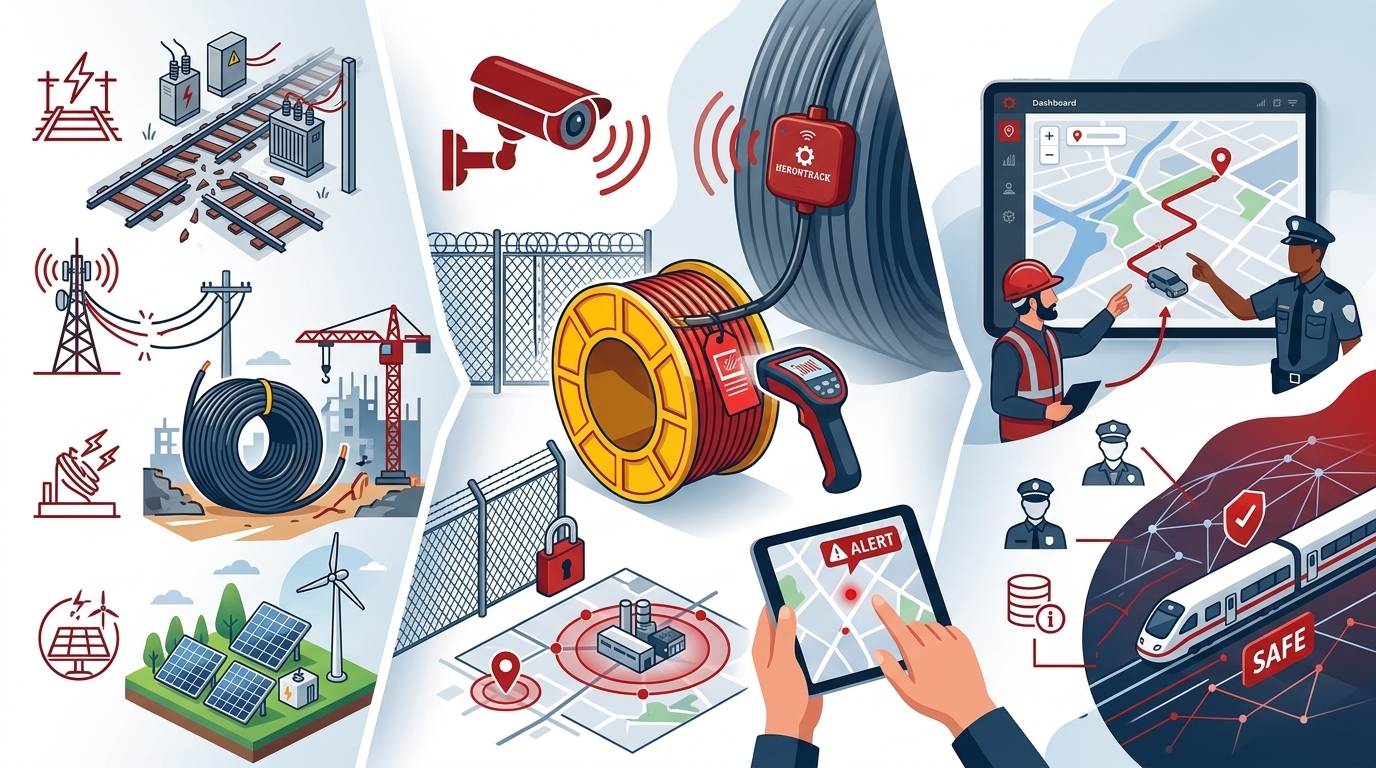
Copper theft poses a significant threat to businesses, infrastructure managers, and network operators. Construction sites, rail facilities, telecommunications networks, industrial sites, and energy infrastructure are among the primary targets.
The value of copper partly explains why thieves are attracted to it. However, the price of the stolen metal often represents only a small portion of the actual loss. A cut cable can disrupt a railroad line, delay a construction project, disable critical equipment, or temporarily deprive users of electricity or telecommunications services.
To reduce these risks, companies must combine several measures: physical security, internal organization, asset tagging, and tracking technologies capable of quickly detecting suspicious movement.
Copper Theft in France and Belgium: Scope and Statistics
There are not always recent national statistics that specifically distinguish copper theft from other types of metal theft. Nevertheless, the figures published by infrastructure managers provide a measure of the scale of the problem.
In Belgium, Infrabel recorded 361 incidents of copper cable theft in 2018, 315 of which had a direct impact on rail traffic. These incidents caused a cumulative total of 51,675 minutes of delays—more than two hours per day. The network operator estimated the resulting financial loss at several million euros. In 2019, more than 200 cable thefts continued to disrupt train service, despite a decrease compared to the previous year. These figures show that just a few meters of stolen cable can have disproportionate consequences for critical infrastructure.
France faces the same risks, particularly with regard to its rail, power, and telecommunications networks. Thefts often occur in remote areas, at temporary construction sites, or along extensive stretches of infrastructure that are difficult to monitor continuously.
The number of incidents can vary significantly from year to year. It depends, in particular, on the price of copper, the activity of organized groups, resale opportunities, and the level of security at the sites. A temporary decrease in thefts therefore does not mean that the threat has disappeared.
Why Copper Is in the Spotlight: Metal Prices and Resale
Copper is valued for its excellent electrical and thermal conductivity. It is used in electrical cables, railroad systems, telecommunications networks, buildings, industrial equipment, and renewable energy infrastructure.
Several characteristics make this metal particularly attractive to thieves:
- its relatively high value on the metals market;
- steady international demand;
- its presence in numerous infrastructure projects;
- its potential for resale as cable, bare metal, or recycled material;
- the difficulty in identifying the owner when the metal is unmarked.
The price of copper also plays an important role. When the price rises, cables stored at a construction site or installed in a remote area become more attractive to illegal resale networks.
Thieves, incidentally, don’t always go after the largest quantities. They sometimes prefer cables that can be accessed quickly, transported in a utility vehicle, and resold without being immediately identifiable.
Key targets: construction sites, rail networks, telecommunications, and energy
Copper theft affects many sectors, but some infrastructure is more vulnerable than others.
Construction sites are a frequent target. However, certain measures can help better protect and locate tools on a construction site, including securing access points, maintaining a digital inventory, and using tracking devices.
Cable reels, industrial extension cords, electrical equipment, and technical materials are sometimes stored there prior to installation. The irregular presence of crews, constant changes in site organization, and the involvement of multiple subcontractors can make monitoring more difficult.
Railroad networks are particularly vulnerable due to their length and the fact that they run through remote areas. Copper is used in these networks in electrical systems, signaling equipment, and various technical installations. The theft or damage of a cable can immediately affect train safety and traffic.
On rail networks, even a single power outage can disrupt signaling systems and cause significant delays. To protect these facilities—which are difficult to monitor continuously—HeronTrack offers a solution to prevent copper theft on railways, capable of detecting suspicious movements and quickly transmitting the location of the incident.
Telecommunications infrastructure is also affected. An outage can cause service interruptions for individuals, businesses, or public utilities. In some regions, the gradual replacement of copper with fiber optics is reducing the available capacity, but the existing cables remain in high demand.
Finally, energy production and distribution facilities contain large quantities of cables. Substations, solar power plants, wind farms, and industrial buildings can be targeted, especially when they are remote or have little foot traffic.
How Thieves Operate: Reconnaissance, Modus Operandi, and Fencing
A copper theft is rarely completely improvised. The perpetrators may begin by surveying the site to identify work schedules, secondary entrances, the presence of cameras, and the routines of security personnel.
Reconnaissance can be conducted from a public road or under the guise of a business visit, a delivery, or a request for information. Some thieves wear work clothes and use utility vehicles to blend into the surroundings of a construction site.
Once the target area has been identified, the cables are cut, removed, or loaded into a vehicle. Thefts often occur at night, on weekends, or during closing hours. At large infrastructure sites, thieves look for locations where their activities will be detected less quickly.
The metal can then be stripped, cut up, and mixed with other materials to make it harder to identify. It is then sold to a middleman, transported to another region, or exported. This rapid transformation explains why the response in the first few minutes or hours is critical.
The consequences for a company: direct costs, delays, penalties, and insurance
The replacement value of the copper is only one component of the damages. A company that has suffered a loss must also take into account damage to equipment, response costs, time spent assessing the damage, and operational consequences.
On a construction site, a theft can halt work until new cables are delivered. This interruption ties up crews unnecessarily and can result in contractual penalties if deadlines are not met.
On a rail, power, or telecommunications network, the repercussions can be much more severe. An outage can cause delays, service interruptions, the urgent mobilization of technical crews, and safety risks.
Indirect costs include, among other things:
- replacing damaged cables and equipment;
- repair and restoration costs;
- lost work hours;
- additional security measures;
- delays in delivery or performance;
- contractual penalties;
- a possible increase in the insurance premium;
- damage to the company's reputation.
To determine the true cost of a theft, it is therefore necessary to assess all of its consequences, not just the market value of the stolen copper.
What the Law Says: Criminal Offenses and Penalties
In France, theft is defined in Article 311-1 of the Penal Code as “the fraudulent taking of another person’s property.” Simple theft is punishable by three years’ imprisonment and a fine of 45,000 euros.
Penalties may be more severe if there are aggravating circumstances. This is particularly the case when the theft is committed by multiple individuals, in a location intended for the storage of goods or equipment, or when it involves destruction or damage. Depending on the circumstances, sentences may range from five to seven to ten years in prison. Theft committed by an organized gang is subject to even harsher penalties.
Receiving stolen property is also a crime. A person who knowingly conceals, possesses, or transfers property obtained through theft may be prosecuted, as may anyone who acts as an intermediary in its resale.
In Belgium, theft, receiving stolen property, and related acts of vandalism may also be subject to criminal prosecution. The applicable classification and penalty depend on the circumstances: for example, breaking and entering, the involvement of multiple individuals, damage to critical infrastructure, or endangering traffic.
Companies must retain any information that could help identify the property: invoices, serial numbers, photographs, inventory lists, markings, and location data. This evidence can facilitate the investigation and the return of recovered equipment.
Requirements and Traceability in Metal Buybacks
The fight against copper theft is not limited to the perpetrators themselves. It also targets the channels through which stolen metals can be resold.
In France, professionals who buy or resell used personal property—including certain metal dealers—are subject to traceability requirements. In particular, they must maintain a record identifying the items acquired and the individuals who supplied them. Furthermore, cash payments for the purchase of metals from private individuals are prohibited.
In Belgium, metal buyers and recyclers must also comply with identification and traceability rules. These requirements are intended to limit anonymous transactions and enable authorities to trace the path of a suspicious shipment.
To be effective, this traceability must be based on a sufficiently detailed description: type of metal, quantity, date of the transaction, seller’s identity, and, when possible, the origin of the material. Permanent marking or a unique identifier significantly increases the likelihood of determining that a recovered cable is stolen.
Physical Prevention: Site Security, Storage, Lighting, and Markings
The first step is to make it more difficult to gain access to copper and to make theft riskier. A site analysis should identify storage areas, access points, out-of-sight locations, and times when equipment is left unattended.
Uninstalled reels and cables must be stored in a closed, locked area that, if possible, is not visible from the public right-of-way. It is also recommended to limit the quantities stored by scheduling deliveries to coincide with the actual construction schedule.
Automatic lighting, fences, reinforced gates, and video surveillance serve as deterrents. However, they must be positioned strategically to avoid blind spots. The footage must be stored in accordance with applicable data protection regulations.
Marking equipment, on the other hand, makes it more difficult to resell. This can take the form of an engraving, a specific paint mark, an identification tag, or a unique code linked to the company’s inventory.
Finally, teams must be made aware of certain warning signs: an unfamiliar vehicle, an unauthorized person on site, unusual photographs of the facilities, or the repeated disappearance of small amounts of cable. A clear protocol must specify who to report these situations to.
Technology-Based Prevention: Geolocation, Beacons, and Out-of-Zone Alerts
Physical security measures slow down thieves, but they do not always allow for the immediate detection of an attempted theft. Geolocation systems and connected sensors add the ability to respond in real time.
A discreet tracking device can be attached to a coil, piece of equipment, or sensitive infrastructure. Depending on the technology used, it transmits its location and alerts the user to movement, impact, vibration, or a change in tilt.
Geofencing involves creating a virtual geographic zone around a construction site, a warehouse, or a section of infrastructure. When a tracked asset leaves this zone without authorization, the system automatically sends an alert.
To be effective, this technology must be integrated into an incident response procedure. The alert must reach the right people, with information that can be acted upon immediately: affected equipment, time of movement, location, and movement history.
Geolocation, therefore, does not replace fences, access controls, or video surveillance. It complements these measures by reducing the time between when a theft begins and when it is detected.
DNA Marking and Cable Tracing Solutions
DNA marking uses a synthetic substance that contains a unique identifier. This substance, which is generally invisible to the naked eye, can be applied to cables, reels, or equipment.
When a suspicious item is found, an analysis can be conducted to trace the item back to its owner. This system can also serve as a deterrent when it is clearly posted on the site.
Other tracking solutions can be used, such as microdots, engravings, durable labels, industrial QR codes, or microchips. Their purpose is to maintain a usable identity even when the equipment has been moved or partially modified.
DNA marking is primarily used for identification purposes after an item has been recovered. Trackers and sensors, on the other hand, are used for detection and location purposes. Combining these two approaches therefore helps strengthen prevention, response, and evidence collection.
What to Do Immediately After a Theft: Documenting the Incident, Filing a Report, and Making a Statement
When copper theft is detected, the priority is to secure the area. Cut cables may pose an electrical hazard or compromise the operation of a system. Do not handle the equipment until a qualified person has assessed the situation.
In France, a business can file a theft report at a police station or a gendarmerie, or, in certain situations, use the online reporting service.
In Belgium, the police record the complaint in an official report. The Federal Public Service of Justice also explains the victim’s rights during the interview.
Next, it is important to preserve the evidence and document the situation:
- take photographs of entry points, signs of forced entry, and damaged equipment;
- Record the time of discovery and the last known time the equipment was present;
- save the CCTV footage;
- export geolocation data and the alert history;
- compile a list of the stolen property and estimate its value;
- collect the contact information of any witnesses;
- file a complaint with the police or the gendarmerie;
- Notify the insurer promptly.
If a tracker is still showing the equipment's location, it is best to report this information to law enforcement. Employees should not attempt to recover the copper themselves, as doing so may be dangerous.
Insurance: Conditions for Compensation and Required Proof
Compensation depends on the coverage provided in the insurance policy. Some policies cover stored equipment but require specific measures: a fenced-in site, a locked facility, an active alarm system, or no outdoor storage overnight.
The company must therefore review the exclusions, coverage limits, deductibles, and reporting requirements. Failure to comply with a safety requirement specified in the contract may reduce or prevent compensation.
Documents typically required include:
- the receipt or report confirming the filing of the complaint;
- purchase invoices;
- the equipment inventory;
- photographs taken before and after the flight;
- CCTV footage;
- evidence of a break-in;
- geolocation reports;
- repair and replacement estimates;
- an estimate of operating losses.
A continuous inventory of equipment greatly simplifies these procedures. It provides proof of which equipment was on site prior to the theft and allows for the quick retrieval of part numbers, invoices, and last known locations. It provides proof of which equipment was on site and allows for the quick identification of the relevant part numbers.
Track Your Equipment and Reels with HeronTrack
Preventing copper theft becomes more effective when a company knows the location of its equipment and can be alerted as soon as unusual activity is detected.
HeronTrack allows you to track equipment and reels from a centralized platform. Sensors can detect movement, vibrations, impacts, or changes in tilt that may indicate an attempted theft. GPS tracking then helps security teams or law enforcement identify the exact location of the incident.
In the rail industry, where cables may run along kilometers of track that are difficult to monitor, this responsiveness is a decisive advantage. Alerts can be sent in real time via an app, text message, or phone call to predefined contacts and a monitoring center.
The solution is self-contained, unobtrusive, and well-suited for remote locations. It can be installed on cables, equipment cabinets, or other sensitive equipment without requiring major changes to the infrastructure.
Discover the copper theft prevention solution for railways developed by HeronTrack to detect attempted thefts, pinpoint the location of incidents, and reduce service disruptions.
To prevent copper theft in the long term, no single measure is sufficient on its own. The most effective strategy combines physical security, strict access control, cable marking, equipment traceability, and a real-time alert system. This approach reduces opportunities for theft and empowers teams to take action before significant damage occurs.