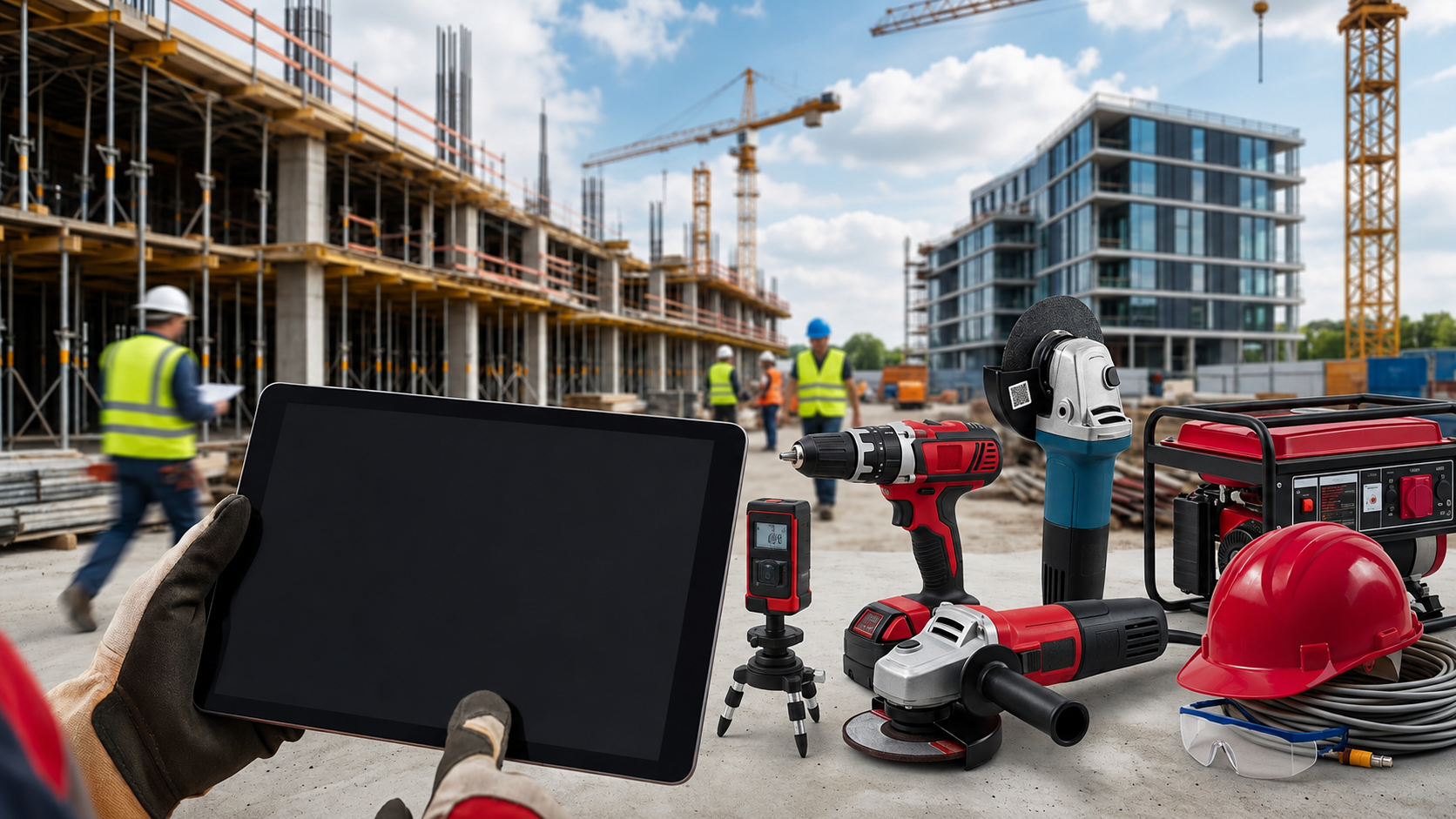
On a construction site, a defective or missing tool can quickly disrupt an entire team. A drill that breaks down, an aerial work platform whose inspection is past due, or a poorly maintained generator can lead to delays, unexpected expenses, and safety risks for employees.
These problems are not always due to a lack of equipment. They often stem from poorly structured management: unidentified tools, missed maintenance, scattered information, a lack of historical data, or poorly defined responsibilities. In the long term, these shortcomings result in significant hidden costs and reduce the equipment’s service life.
Tool maintenance, therefore, is not just about repairing a piece of equipment when it stops working. It relies on a comprehensive system that combines maintenance, inspections, checks, traceability, and proactive planning. Thanks to digitalization, companies can now centralize these operations, automate reminders, and better track their equipment—even when it is being moved between multiple job sites.
Tool maintenance—what is it?
Tool maintenance refers to all actions taken to keep tools and work equipment in good working order. It includes, in particular, cleaning, inspection, adjustment, lubrication, replacement of parts, repair, and safety checks.
It applies to both small power tools, such as drills and angle grinders, and larger equipment, such as aerial work platforms, generators, and certain construction machines. Ladders, extension cords, lifting equipment, and measuring devices can also be included in a maintenance program.
Maintenance is generally divided into three main categories.
Corrective maintenance is performed after a breakdown or defect has been identified. Its purpose is to restore the equipment to working order. This approach is sometimes unavoidable, but it can result in work interruptions and unexpected costs.
Preventive maintenance is performed before a breakdown occurs. It is carried out at intervals determined by time, the number of operating hours, the manufacturer’s recommendations, or operating conditions. It allows for the identification of early signs of wear and tear and enables maintenance to be scheduled at the most appropriate time.
Finally, regulatory maintenance encompasses the inspections and checks required by law or safety regulations applicable to certain categories of equipment. The specific requirements vary depending on the type of equipment, its use, and the country in which it is operated.
An effective strategy combines these different approaches to minimize downtime while protecting users.
Why is tool maintenance essential?
Reducing Breakdowns on Construction Sites
A breakdown can slow down a task, bring a team to a standstill, or halt part of the construction site. When the affected tool is essential and no replacement equipment is available, the impact can affect the entire schedule.
A structured tool maintenance program helps identify wear, defects, or malfunctions before they cause a complete shutdown. Replacing a cable, disc, filter, or battery in advance is generally less expensive than an emergency repair that results in a work stoppage.
Improving Team Safety
A poorly maintained tool poses a direct risk to its user and to people nearby. A defective safety device, a damaged handle, or a worn-out electrical cord can cause an accident.
Regular inspections help detect these defects and quickly remove hazardous equipment from service. Every employee must also be able to easily report a problem so that the equipment can be identified, taken out of service, and inspected before its next use.
Reduce replacement costs
Without careful monitoring, some companies replace equipment too quickly that could have been repaired. Conversely, they may continue to invest in repairs when replacing the equipment would be more cost-effective.
The maintenance history provides a more objective view. It allows for a comparison of the cumulative cost of repairs, the equipment’s age, how often it is used, and its reliability. This enables the company to make better purchasing and replacement decisions.
Extend the service life of tools
Dust, moisture, impacts, and heavy use accelerate wear and tear on construction equipment. Regular cleaning, proper storage, and the preventive replacement of vulnerable parts help maintain the equipment’s performance.
Well-planned maintenance limits premature wear and tear and allows tools to be used for longer under good conditions. The initial investment thus pays for itself over a longer period.
Ensuring Regulatory Compliance
Certain equipment must undergo periodic inspections or checks. The company must be able to demonstrate that the necessary inspections were performed on time and that any issues were addressed.
Traceability plays a central role here. Dates, results, documents, responsible parties, and upcoming deadlines must be clearly recorded. In the event of an audit or incident, this information makes it possible to quickly locate the available evidence.
Which tools need to be maintained regularly?
Not all tools require the same level of maintenance. The frequency and scope of inspections depend on the risk, the intensity of use, the environment, and the manufacturer’s instructions.
|
Equipment Category
|
Examples |
Routine Operations
|
|
Power Tools
|
Drills, grinders, screwdrivers, saws
|
Cleaning, inspection of cables, batteries, blades, and guards
|
|
Access Equipment
|
Ladders, step stools, rolling scaffolds
|
Inspection of stability, rungs, fasteners, and safety devices
|
|
Motorized equipment
|
Generators, compressors, pumps
|
Visual inspection, level checks, startup, and leak testing
|
|
Equipment for Working at Heights
|
Aerial Work Platforms and Lifts
|
Control of controls, safety devices, levels, and scheduled inspections
|
|
Measuring Equipment
|
Lasers, sensors, measuring instruments
|
Cleaning, functional testing, and calibration as needed
|
|
Small Hand Tools
|
Wrenches, pliers, hammers, screwdrivers
|
Inspection for wear, handles, and metal parts
|
|
Lifting Equipment
|
Hoists, winches, lifting accessories
|
Visual inspection, wear checks, and periodic inspections
|
|
Electronic Equipment
|
Extension cords, cord reels, power strips
|
Inspection of outlets, cables, protective covers, and insulation
|
Critical equipment, equipment subject to heavy use, or equipment used under harsh conditions generally requires extra attention.
Steps for Implementing an Effective Tool Maintenance Program
1. Conduct a comprehensive inventory
The first step is to take inventory of all the company’s equipment. Each piece of equipment must be assigned a unique identifier and linked to key information: brand, model, serial number, date of purchase, value, location, and assigned user or job site.
This inventory serves as the basis for the maintenance plan. Without a reliable list, some tools may be overlooked during inspections.
2. Identify critical equipment
Not all equipment has the same level of priority. It is helpful to identify the equipment whose failure would have significant consequences for safety, productivity, or the continuity of the construction site.
This classification may take into account the cost of the tool, how often it is used, its availability, the time required to replace it, and the risks associated with its operation.
3. Determine the maintenance schedule
Inspection intervals should be determined based on the operating and maintenance instructions, applicable requirements, frequency of use, and actual on-site conditions.
A tool used daily in a dusty environment may require more frequent inspections than a similar tool used only occasionally. The program must therefore remain flexible.
4. Standardize controls
To ensure consistent inspections, the company can create checklists tailored to each category of tools. Technicians and users will then know exactly which items to inspect.
A checklist may include general condition, functionality, safety features, consumables, cables, batteries, fasteners, and visible damage.
5. Track the history of service calls
Every maintenance or repair must be recorded. The maintenance history should include the date, the nature of the work, the parts replaced, the cost, the name of the person responsible, and the result of the inspection.
This data makes it easier to analyze equipment reliability. It also helps identify tools that break down frequently or whose maintenance costs are becoming excessive.
6. Automate reminders
When deadlines are managed manually, it’s hard to avoid oversights. Automatic reminders can alert managers before the date of an inspection, maintenance, or checkup.
The company can then schedule the repair, reserve replacement equipment, and minimize the impact on the job site.
A Concrete Example of a Tool Maintenance Plan
The following diagram illustrates one possible configuration. The frequencies listed must always be adapted to the manufacturer’s instructions, operating conditions, and applicable requirements.
|
Equipment
|
Check to be performed
|
Approximate frequency
|
Manager
|
Action to Take in Case of an Anomaly
|
|
Cordless Drills
|
Battery, Chuck, Housing, and Operation
|
Every month
|
Equipment Manager
|
Temporary Withdrawal and Diagnosis
|
|
Grinder
|
Housing, cable, handle, switch, and disc
|
Before use and once a month
|
User and Equipment Manager
|
Immediate tool lock
|
|
Scale
|
Rails, Feet, Uprights, and Stability
|
Before use and periodically
|
Site Manager
|
Decommissioning
|
|
Generator set
|
Oil, Filters, Fuel, Cables, and Starting System
|
Based on hours of use
|
Technician
|
Scheduled maintenance or repair
|
|
Work platform
|
Controls, Safety Features, Levels, and Documents
|
Depending on the applicable program
|
Competent person
|
Immobilization and Control
|
|
Measuring laser
|
Status, battery, accuracy, and calibration
|
Every 6 months
|
Quality Manager
|
Adjustment or Calibration
|
Common Mistakes in Tool Management
One of the most common mistakes is to spread information across multiple Excel files, paper files, or email exchanges. This makes it difficult to keep the data up to date, and managers no longer know which version to refer to.
The lack of traceability is another major problem. When a tool is not identified, it becomes difficult to know its location, who is using it, its condition, and the date of its last maintenance.
Some companies also take a purely reactive approach: they wait for equipment to break down before taking action. This method may seem cost-effective in the short term, but it leads to more urgent repairs and unplanned downtime.
Inspection oversights are particularly common when deadlines rely on a single employee’s personal calendar. Finally, equipment shared among multiple teams or job sites may change hands without anyone being clearly responsible for checking it.
Why digitize tool maintenance tracking?
Digitization makes it possible to consolidate all equipment-related information into a centralized system. Teams have a clear overview of the location, status, due dates, and history of each piece of equipment.
Thanks to a QR code affixed to the equipment, an employee can quickly identify it, view its details, or report a problem while in the field. Information is no longer confined to a file that can only be accessed from the office.
Automatic alerts make it easier to prepare for jobs and reduce the likelihood of oversights. Multi-site visibility, meanwhile, helps managers know which tools are available, undergoing maintenance, assigned to a job site, or temporarily unavailable.
The data collected can also be used to generate reports on costs, the frequency of breakdowns, utilization, and fleet availability. This greater insight supports a return on investment: the company reduces losses, minimizes unnecessary purchases, and improves the availability of its equipment.
Implementing a maintenance tracking system makes it possible to schedule service calls and anticipate breakdowns.
How HeronTrack Simplifies Tool Maintenance
An effective maintenance approach depends first and foremost on clear procedures and the involvement of the teams. A digital solution can then make it easier to implement these procedures on a daily basis.
HeronTrack allows you to centralize equipment tracking and improve traceability across employees, depots, and job sites. Geolocation and real-time tracking help you locate equipment and identify its last known location.
Each piece of equipment can have a history that includes its movements, users, inspections, and service calls. Automatic alerts can notify managers when a maintenance task or inspection is approaching.
Usage-based monitoring also makes it possible to tailor certain maintenance tasks to the actual use of the equipment, rather than relying solely on a fixed date. This gives managers a more accurate picture of the condition and availability of the tools.
In an organization with multiple job sites, this centralization reduces the need for searches, improves the flow of equipment, and simplifies the assignment of responsibilities. It allows for the integration of tool maintenance into a more comprehensive management of the equipment inventory, including its location and use.
To learn about the available features, check out the HeronTrack asset tracking solution.