Why BLE-tracking is more efficient than RFID-tracking for tool management in the Construction industry

Many construction companies rely on RFID-tracking to track and manage their tools and equipment. However, a newer technology has been around for a few years now, and offers significant advantages over RFID: BLE (Bluetooth low Energy). Find out more in this article.
During the execution of a construction project, it can easily happen that tools are lost, stolen or misplaced. It is therefore essential to have a reliable tracking system to monitor the location of tools and equipment. BLE-based tracking systems are an excellent alternative to traditional RFID asset tracking systems.
What is BLE?
BLE (Bluetooth Low Energy) is a wireless communication technology that enables devices to communicate with each other over short distances. It uses the same basic principles as traditional Bluetooth, but with much less energy. This makes it ideal for applications where energy efficiency is an important consideration, such as tool tracking.
How does a BLE tracking system for tools work?
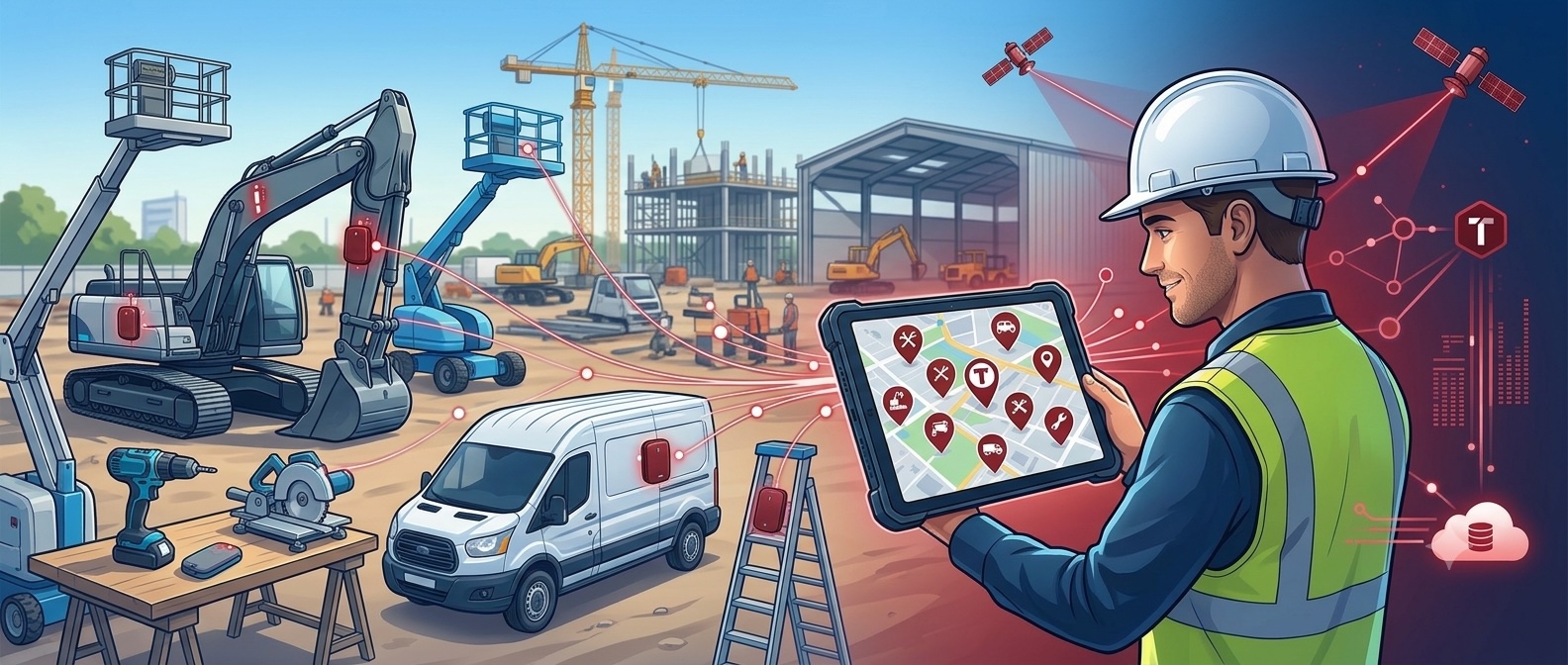
Tool tracking with BLE is a method of tracking and managing tools and equipment using BLE trackers and an associated application. BLE trackers are installed in the tool or equipment and then communicate with an app on a smartphone or tablet. In this way, you can track the location of the tool or equipment in real time.
Curious about how a BLE-tracking system works? Read the article "How tool tracing works".
What advantages does BLE offer over RFID tracking?
1. Better precision
RFID-tracking often works with passive tags that are only detected when within range of an RFID reader. This is sufficient for applications where only the presence of an item needs to be verified. For example, to check whether a certain tool is in a certain place.
However, if you want to know the exact location of your tools, you're better off using BLE-tracking. This technology works with active trackers that emit a constant Bluetooth signal. In this way, a tool's location is determined much more accurately, even if it's in a confined space.
Active RFID trackers are also available, but if you want a lifespan comparable to that of BLE trackers, active RFID trackers are much bigger and more expensive.
2. Easy integration with mobile devices
Thanks to BLE technology, you can easily use your smartphone or tablet as a reader for your tool tracking system. This way, you don't need to buy separate BLE readers, and your employees can easily find all their tools with their own smartphone.
3. Lower costs
Active RFID trackers and readers are relatively expensive, especially if you need a lot of tags and readers to track your inventory of many tools. What's more, you have to replace the trackers regularly, which adds to the cost. BLE trackers are cheaper and generally last longer than RFID trackers. What's more, you don't need separate BLE readers, as you can easily monitor all your tools with your smartphone. In this way, you save considerably on the costs of your tool tracking system.
4. Greater reliability
Compared with RFID-tracking, BLE is much more reliable in construction environments, where many environmental factors can affect RFID operation. Think, for example, of metal structures and concrete walls. BLE is much less affected by this, so it works much better in an environment with many obstacles.
The Physical and Logistical Limitations of RFID on Construction Sites
Although RFID (Radio-Frequency Identification) technology is extremely effective in a controlled environment such as a central warehouse, its exclusive use on a construction site presents certain challenges. One of the main obstacles is environmental interference. The radio waves used by passive RFID tags can be disrupted, absorbed, or reflected by dense materials commonly found in the construction industry, such as reinforced concrete, steel scaffolding, or large quantities of liquids. This can create “dead zones” where the scanner is unable to detect the tool, even if it is only a few meters away.
Furthermore, traditional RFID systems often rely on mandatory checkpoints (or “choke points”). For example, a detection gate installed at the entrance to a shipping container used as a warehouse. If a tool is thrown over a fence or bypasses this gate, the system loses track of it. This is why RFID requires strict discipline from teams, which is not always compatible with the urgency and fast-paced nature of field operations.
Toward a Hybrid Solution: The Combination of RFID, Bluetooth (BLE), and GPS
To overcome these challenges, the most innovative construction companies are now turning to hybrid equipment tracking solutions. Rather than relying on a single technology, a smart platform like Herontrack combines the strengths of multiple systems to ensure seamless traceability:
- Passive RFID:Ideal for quickly and comprehensively taking inventory of small consumables or personal protective equipment (PPE) inside the central warehouse. The tags cost just a few cents and do not require batteries.
- Bluetooth Low Energy (BLE):It’s a true revolution for construction sites. BLE sensors emit a continuous signal that is automatically picked up by workers’ smartphones running the app. This creates a decentralized, passive tracking network: as soon as a worker passes near a grinder or a hammer drill, their location is updated on the map without any manual action on their part.
- Active GPS:Designed exclusively for heavy equipment (excavators, compressors, generators), GPS provides real-time, autonomous global positioning.
By consolidating these three technologies into a single management software solution, tooling managers gain complete visibility into their fleet, from the warehouse to even the most remote job site.
Device Tracking and Privacy: What About the GDPR?
The implementation of an RFID or Bluetooth tracking system often raises legitimate concerns about employee privacy. It is crucial to reassure your teams: the sole purpose of asset tracking is to locate objects, not individuals.
Under the GDPR (General Data Protection Regulation), modern solutions anonymize the data collected by smartphones. The app simply acts as a technical bridge to transmit the location of the tracker attached to the device to the cloud server. Transparency and communication remain the keys to successful adoption by your field teams.
Conclusion: BLE vs RFID tracking
Are you looking for a reliable and affordable tool tracking system to easily and accurately track and manage your tools and equipment? If so, a BLE-based tracking system is a smarter choice than RFID tracking.
Get started now with HeronTrack BLE tracking software
HeronTrack is the ultimate BLE tracking tool for tracking, inventorying and managing all your tools. It makes tool management easier and faster. And it doesn't have to be complex or expensive at all. Our efficient, discreet sensor locates your tools, ensures their safety and schedules maintenance for less than 3 euros a month.
Would you like to start using HeronTrack's BLE tracking software today? Order your version now at https://herontrack.com/caracteristiques/